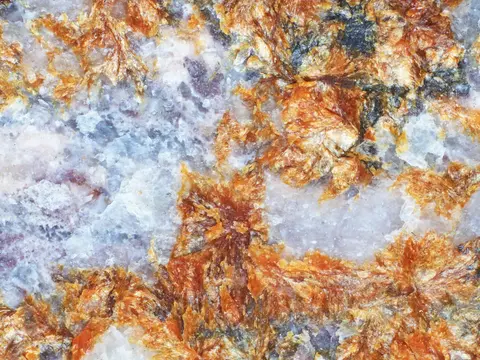

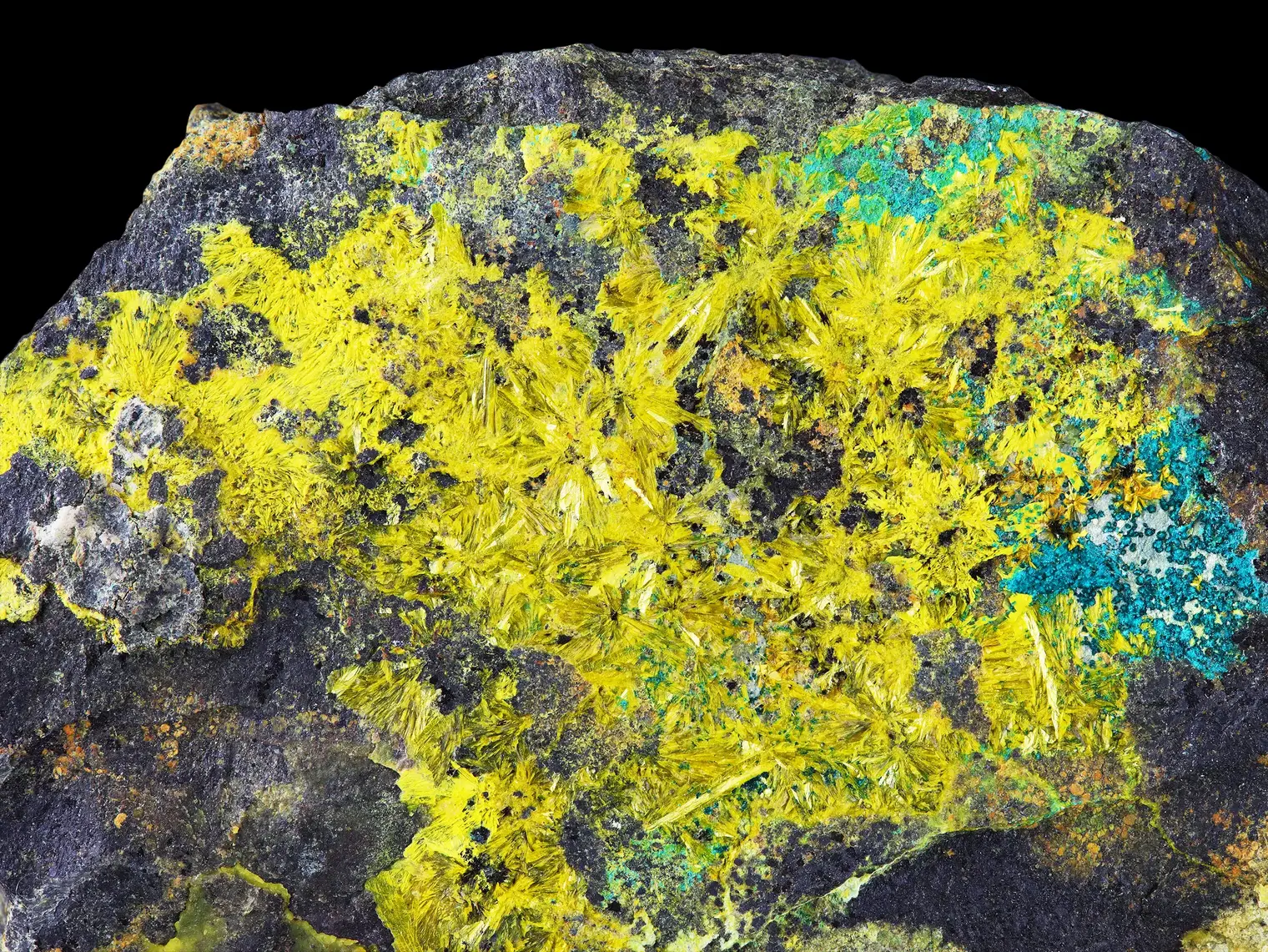
![[Translate to English:] Roche grise, jaune et bleue](/fileadmin/_processed_/e/c/csm_093287_Kamotoite-_Y__Astrocyanite-_Ce__Kamoto_RDC_5x2x4_5cm_3461a0985e.webp)
New mineral species
Discovery and Description of New Mineral Species
Describing new mineral species is not simply a matter of assigning a name, but of structuring and deepening our understanding of natural materials, with concrete scientific and economic benefits.
From an academic perspective, each new species provides valuable information about the conditions under which the Earth, meteorites, and rocky planets formed (temperature, pressure, fluids, age). This mineral diversity allows us to refine models in geology, chemistry, and materials science, while sometimes revealing previously unknown properties (new crystal structures or physicochemical behaviors). It also contributes to a rigorous classification system validated by votes within the International Mineralogical Association, ensuring a common scientific language.
Economically speaking, these discoveries are essential for resource exploration. Some minerals serve as indicators of deposits of strategic metals or rare earth elements, while others possess properties useful for energy transitions and advanced technologies (electronics, catalysis, innovative materials).
The study of minerals begins in the field during collection campaigns and continues in the laboratory through analyses and, at times, syntheses. Validated samples are then preserved in reference collections, constituting a lasting scientific heritage accessible to the international community. The Naturéum thus preserves two-thirds of the world’s mineralogical geodiversity.
Project leaders : Nicolas Meisser et Stefan Ansermet