
Information
Public
- All audiences
Geology
Regional geology
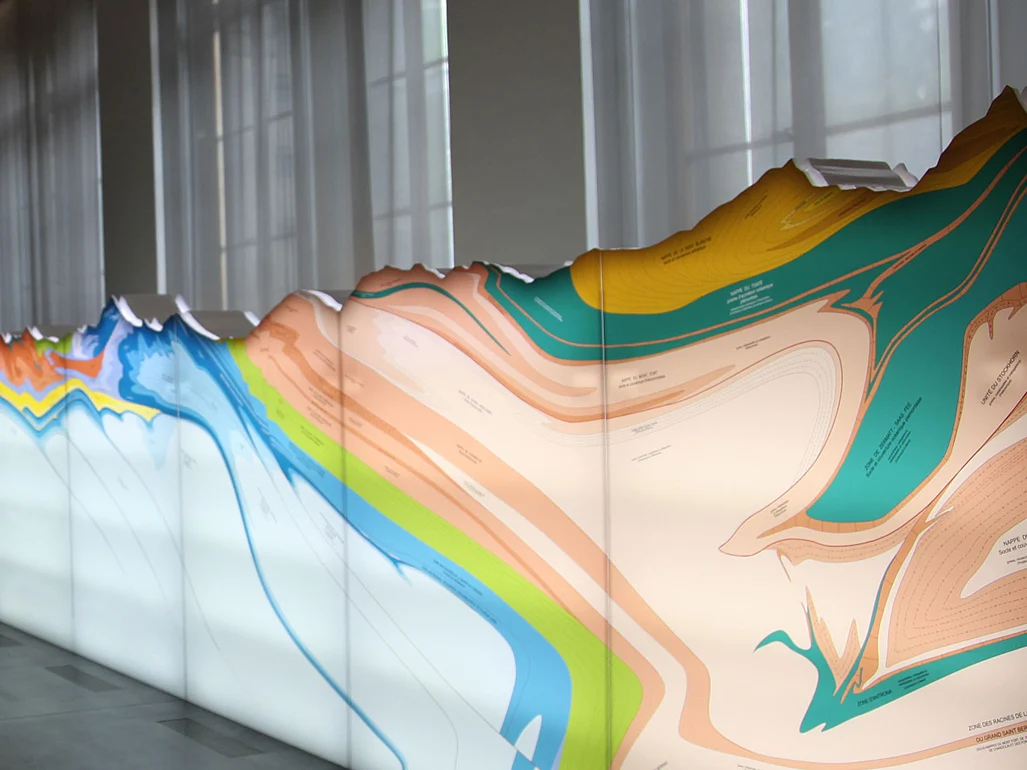
The entire geological heritage of our various natural regions and their fossil sites is represented and catalogued here, from the Jura to the southern slopes of the Alps. Our institution has the most comprehensive collections in existence on the Pre-Alpine massifs and the Valais Alps.
Among the nominal collections, we would highlight those of Pictet and Campiche (ammonites from Sainte-Croix) and Roux for the Jura, Stehlin (mammals from Mormont), Heer (flora from the molasse), Renevier, Jeannet and Gagnebin for the Pre-Alps, Lugeon and Badoux for the limestone Hautes-Alpes, and Argand for the Pennine Alps.
But the most remarkable collection is that of the Tertiary flora of the Lausanne region, with thousands of specimens collected over nearly two centuries. This collection has become an essential global reference with its hundreds of holotypes, a holotype being THE ‘standard’ model used to describe a previously unknown species for the first time.
Applied geology collection
Applied geology is one of the most consulted collections in our geology department: it contains samples from boreholes or sites that are now inaccessible, such as certain old mines or galleries linked to dams or tunnels (whose walls are almost always plastered with concrete). The oil companies that have worked in the canton have deposited the results of their investigations at the Museum, along with core samples and drill samples, including 10 deep exploration boreholes.
The boreholes provide information about the nature of the bedrock in the Vaud region at depths of up to several kilometres. Samples from the construction of hydroelectric and mining galleries and tunnels are also kept at the museum: the Hongrin, Emosson and Salanfe dams, the Glion, Gotthard and Mont Blanc tunnels, the Belmont and Oron mines, etc.
Interestingly, our collection of drill cores is unique in the world. Following the fire that destroyed part of the Mont Blanc tunnel in 1999, the engineers responsible for its reconstruction had to come to Lausanne to learn about the nature of the rocks in the section that had been destroyed by fire. Another valuable collection is that of rocks and minerals from the Simplon tunnel. It lists, practically metre by metre, the different types of rocks and minerals encountered during the drilling of the Simplon Tunnel. This remarkable collection is an invaluable contribution to our understanding of the mineralogy and geology of a deep area of this region. It has not yet been the subject of extensive mineralogical studies and analyses.
Foreign geology collection
In addition to the old excursion collections, the foreign geology collections consist mainly of specimens collected during research work carried out by staff at the Museum and the Faculty of Geosciences and Environment at the University of Lausanne. Some of these collections have been supplemented by donations from researchers at other institutes.
These include:
- Either regional collections, the main ones coming from the Himalayas (Ladakh, Zanskar, Lahoul, Nepal), the mountains of Oman, Greece and Turkey, as well as Greenland, the Canadian Arctic, the western United States (Texas, Nevada) and Costa Rica.
- Or important thematic collections, such as those of marine sediments from the Permian-Triassic period (Baud and colleagues' collections) or foraminifer limestones from Sardinia, Morocco, the former Yugoslavia, Turkey, Oman and Tunisia (Septfontaine collection).
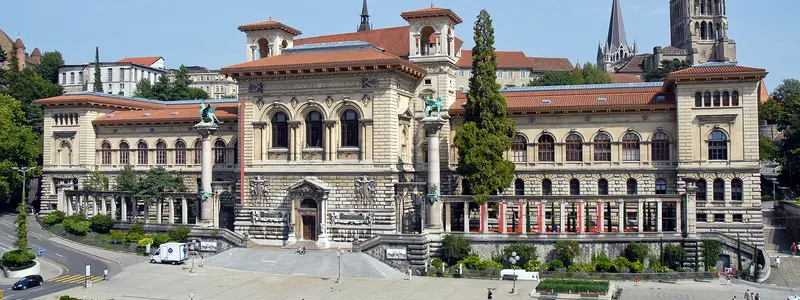
Palais de Rumine
Access
Galleries of Geology : 3rd floor
Galleries of Zoology : 5th floor
Public transportation
Metro M2 or bus no 1, 2, 7, 8, 16, 18, 60 : Station Riponne - M.Béjart
From the train station of Lausanne
Metro M2, direction Croisettes : Station Riponne - M.Béjart
By car : parking de la Riponne
Address
Place de la Riponne 6
CH - 1005 Lausanne
Contact
- Email: info.natureum@vd.ch
Opening hours
The museums are open Tuesday to Sunday, including public holidays, from 10 a.m. to 5 p.m.
Closed on Mondays.
The building is closed on the following days:
In 2026: 01.01, 06.04, 25.06, 03.08, 10.08, 21.09, 25.12.
In 2027 : 01.01, 29.03, 17.05, 20.09, 25.12