
Information
Amber
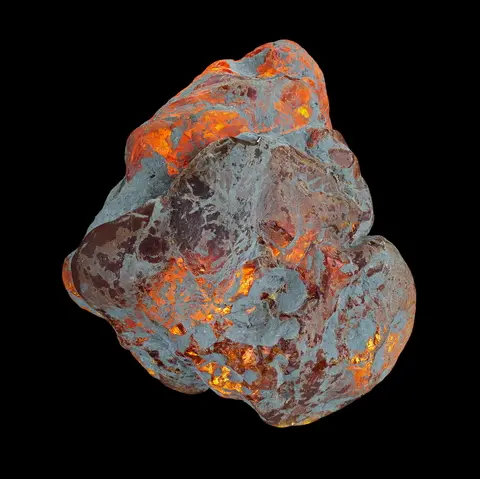
Is it a meteorite filmed in the upper atmosphere as it begins to heat up due to friction with the air? Is it a fragment of volcanic lava still glowing red-hot? None of the above for this strange specimen. It is actually a nodule of amber still partially covered by the sediments in which it was buried. When illuminated from behind, its sumptuous fiery colour pierces the clay matrix that has protected it for nearly 20 million years.
This amber comes from the famous deposits in the Dominican Republic in the Caribbean, but it is rare to be able to acquire it in this raw form, as it is almost always worked and polished as a precious material. This fossil resin comes from a tree that is now extinct, the Hymenaea protera, which thrived in the Miocene epoch. It very often contains insects and other animals that were trapped and perfectly preserved by the fresh, still-liquid resin. Unlike Baltic amber, which is always the same colour, Dominican amber can come in other colours, such as blue or red, as is the case with the piece illustrated here. Gift of the Friends of the Museum Association in 2021.
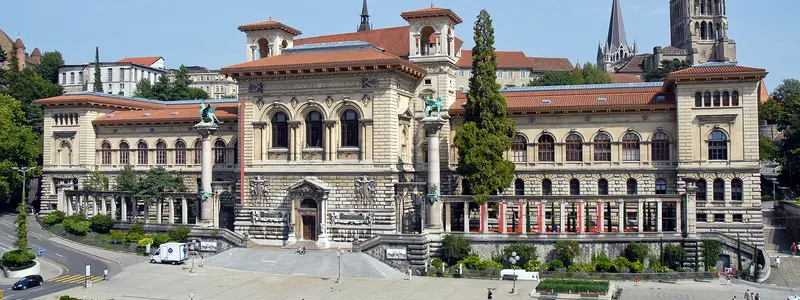
Palais de Rumine
Access
Galleries of Geology : 3rd floor
Galleries of Zoology : 5th floor
Public transportation
Metro M2 or bus no 1, 2, 7, 8, 16, 18, 60 : Station Riponne - M.Béjart
From the train station of Lausanne
Metro M2, direction Croisettes : Station Riponne - M.Béjart
By car : parking de la Riponne
Address
Place de la Riponne 6
CH - 1005 Lausanne
Contact
- Email: info.natureum@vd.ch
Opening hours
The museums are open Tuesday to Sunday, including public holidays, from 10 a.m. to 5 p.m.
Closed on Mondays.
The building is closed on the following days:
In 2026: 01.01, 06.04, 25.06, 03.08, 10.08, 21.09, 25.12.
In 2027 : 01.01, 29.03, 17.05, 20.09, 25.12