
![[Translate to English:] Talus aux Plans-sur-Bex](/fileadmin/_processed_/2/7/csm_Pont_de_Nant_3e26abcd89.webp)
The Flora of Vaud and climate change
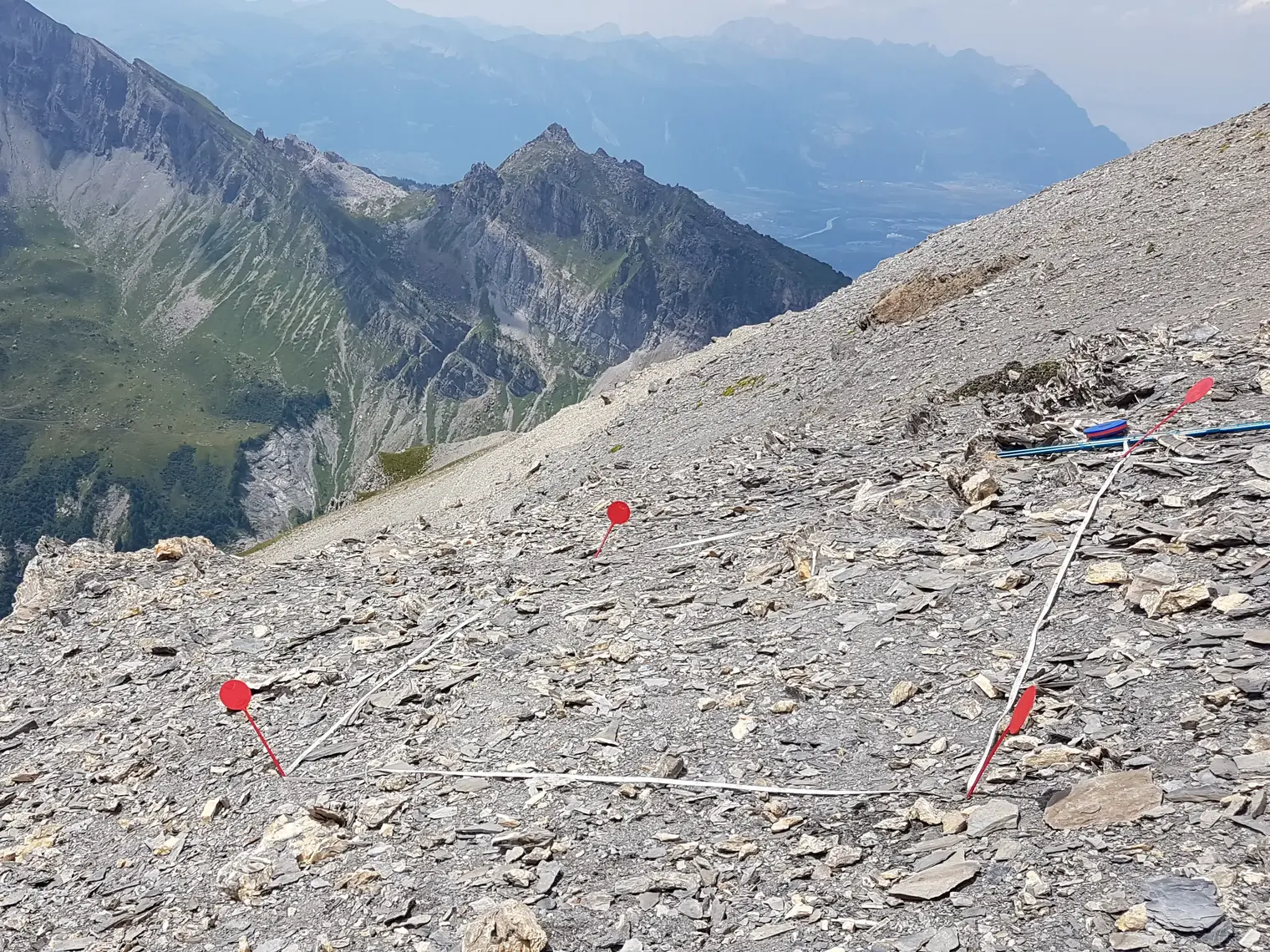
A 4-square-meter permanent plot located in the scree of the Frête de Saille in the Nant valley. Photo: Patrice Descombes
Impacts of climate change and landscape changes on the flora of Vaud
Climate change and landscape transformations, largely influenced by human activities, are causing profound changes in biodiversity. The canton of Vaud is no exception to this trend, with significant losses of flora observed over the past century. In light of this, we are conducting research aimed at better understanding these changes and anticipating their consequences.
Our work focuses on several complementary areas:
- Changes in the flora of the Vaud Pre-Alps: as part of the Resurvey project, conducted in collaboration with UNIL and various partners, we are reanalyzing flora surveys conducted in the early 2000s. These analyses allow us to quantify changes over two decades and identify their climatic and anthropogenic causes.
- Floristic monitoring of the Jorat Nature Park: since the creation of this protected area in 2021, certain forest sectors are no longer being harvested. An inventory of 132 plots (2022–2024) will track the understory flora and assess, over the long term, the effects of non-logging on biodiversity and resilience to climate change. The surveys will be repeated every ten years.
- Species dynamics and expansion: A study focuses on two orchids of the genus Himantoglossum, whose apparent spread within the canton is being analyzed using historical data and distribution models.
- Ecological interactions and conservation: In the Vaud Alps, a project is studying the relationships between the croisette gentian, the specialized butterfly Phengaris alcon rebeli, and ants of the genus Myrmica, highlighting ecological dependencies essential to their conservation.
This research contributes to a better understanding of the effects of global change on biodiversity and provides essential scientific foundations for its conservation.
Project Manager : Patrice Descombes