
Information
Public
- All audiences
Diamond
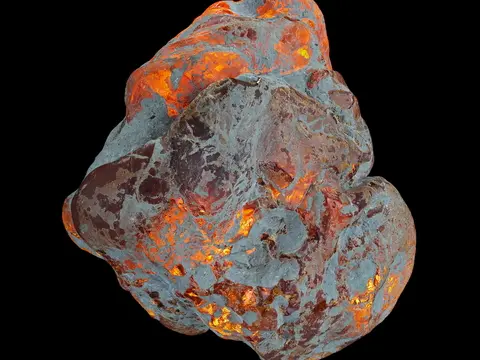
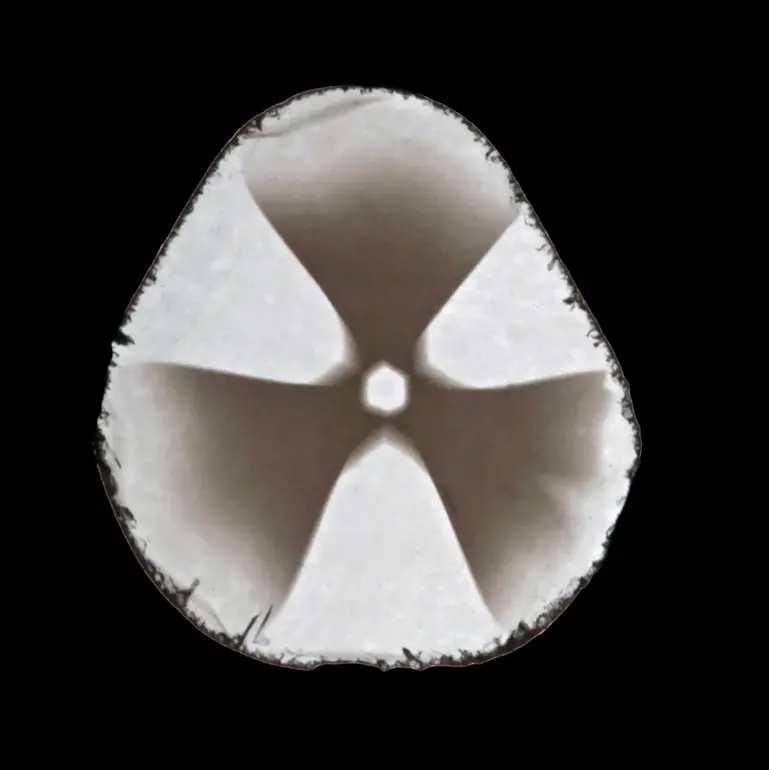
The specimen presented here is probably the most universally famous mineral, as it is a diamond. Everyone knows how rare this stone is, the most precious of all, but this star diamond from Zimbabwe is even rarer.
But how did this three-branched pattern form?
First, when the diamond was formed deep within the Earth, impurities of graphite, nitrogen and hydrogen may have become trapped inside the crystal. But that's not enough. During its growth, the diamond must also change from a cubic to an octahedral habit, creating structural defects in which the impurities concentrate to the point of becoming visible. Known as ‘asteroids’, these extremely rare diamonds from India and Brazil have been known since at least the 18th century, but they have been attracting renewed interest since the 1990s following recent discoveries in Africa. To reveal the star, which can also have four branches, a thin slice must be cut through the crystal at a certain angle. This specimen measures 8 mm at its longest point and is barely a millimetre thick. It was acquired by the Museum in autumn 2022.
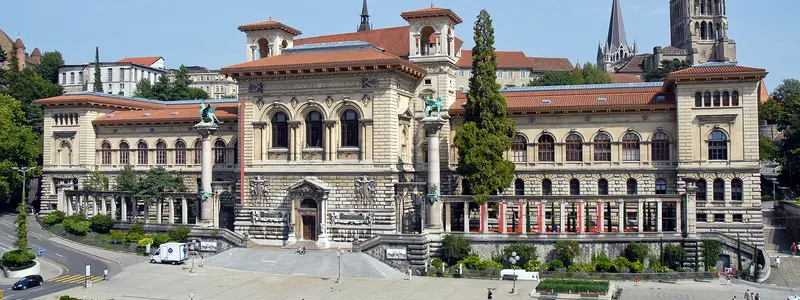
Palais de Rumine
Access
Galleries of Geology : 3rd floor
Galleries of Zoology : 5th floor
Public transportation
Metro M2 or bus no 1, 2, 7, 8, 16, 18, 60 : Station Riponne - M.Béjart
From the train station of Lausanne
Metro M2, direction Croisettes : Station Riponne - M.Béjart
By car : parking de la Riponne
Address
Place de la Riponne 6
CH - 1005 Lausanne
Contact
- Email: info.natureum@vd.ch
Opening hours
The museums are open Tuesday to Sunday, including public holidays, from 10 a.m. to 5 p.m.
Closed on Mondays.
The building is closed on the following days:
In 2026: 01.01, 06.04, 25.06, 03.08, 10.08, 21.09, 25.12.
In 2027 : 01.01, 29.03, 17.05, 20.09, 25.12